My approach to artwork creation
Research is a pillar of my artwork creation process
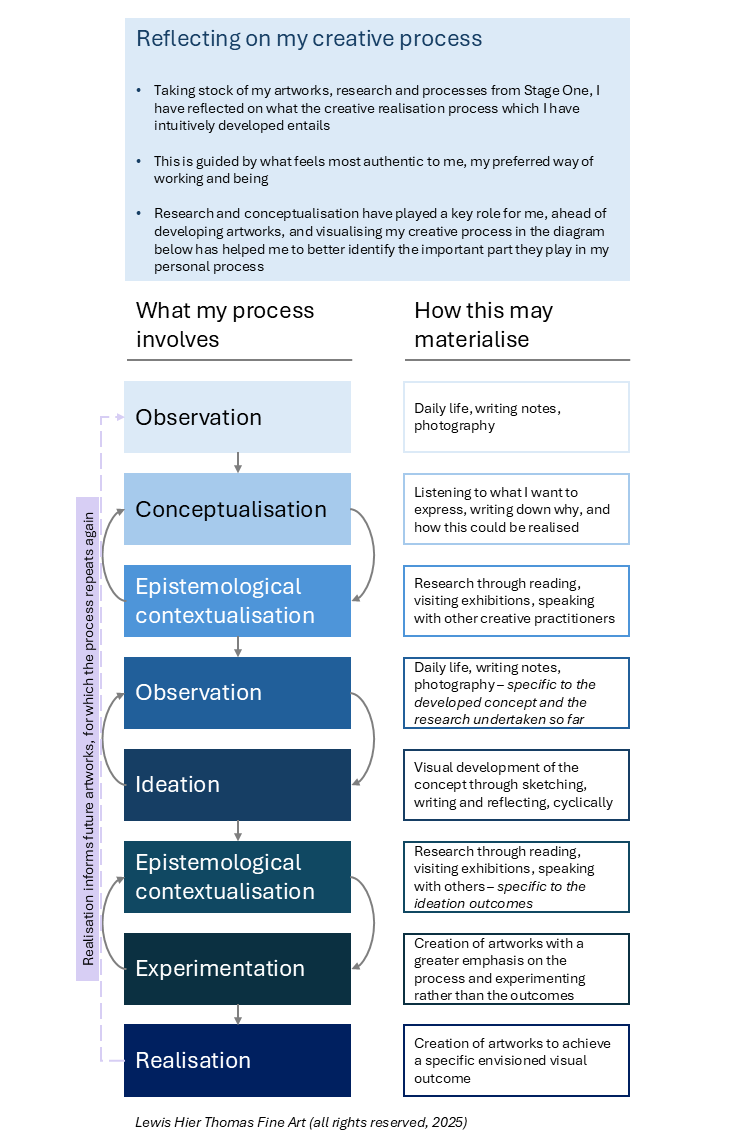
-
Like all artists, I create artwork as myself, as - no matter how hard one might try - the essence of ourself and our lived experience cannot be erased from what we create. I believe this personal and unique diffusing of the self into artwork creation is only a positive, and it forms the majority of the basis from which artworks become implicitly or explicitly relatable for the audience.
Whilst my subconscious psyche will leak into me art in ways I do not fully know, I consciously create my works as - amongst other things - a gay man and through the gay male gaze. Whilst this provides some commonality in experience and relatability to other gay men, it is equally true that my experiences and perspectives are my own and therefore cannot be assumed to be transferrable to other gay men's experiences and perspectives. As a very basic illustrative example, my experiences of being a gay man in London will be different to if I lived in Edinburgh, Hanoi or Los Angeles. Consciously having awareness of this tension and navigating it effectively can make one's practice, works and visual language definitively unique, whilst simultaneously maintaining direct relatability for a specific population group - in this case, other gay men as viewers.
That said, my experience as a gay man has encompassed deeply emotive desire and disgust both internally and externally. I want to play with these complex, often simultaneous, experiences of attraction and repulsion within the heart and mind.
-
Being “in consent with reality”, this is what gay male artist TM Davy asserts as a central pillar to both his life and his practice. He speaks about this – in a podcast interview with actor Russel Tovey and gallery director Robert Diament – as follows:
“There are moments where, I used to have, where I felt as though I was being pushed into stories of my own life, and, I think somewhere around 40, I realised that I should just stay in consent with myself, my own perception of reality. And so, boundaries became a really amazing thing… so that I wasn’t ever feeling outside of my own reality. And that was a really amazing gift I got from my inner child. You know, just to feel like I’m living the dream, and I feel like… you’re in the moment, you’re in your breath, and you know, I accept where I’m at and so I’m in consent with it… Now I just think, [on this podcast interview and other important studio visits] well I’ll just tell them where I’m at, I could just tell them that I’m scared… I mean, I’m a little terrified right now”.(1)
In April last year, I had the pleasure of briefly meeting TM Davy towards the end of his TKE Studios residency in Victoria House, Margate, and the authentic beauty of his work has stuck with me since – through the combination of love, connection, landscape and nature, he is able to say so much, especially through the figures he paints.
TM Davy’s words have made me consider: what does it mean for me to be ‘in consent with’ my reality, with my artwork?
This genuine consent in my practice is something I experienced fully for only the first time when creating my piece “Deconstructing my protectors” on Friday 30th January – the day when, through this work (both in the sense of the labour and the outcome, equally) my primary identity shifted to become that of an artist.(2) I was born an artist, I denied myself of artwork consumption and creation, and now I am returning as an adult to the birth of part of myself which I didn’t allow to develop and mature alongside the rest of myself. So, being an artist has always been an aspect of myself, but I only allowed myself to start intentionally exploring this in 2021. Now, it is my true desire to spend the focus of my time and energy creating, relating, transforming through my visual practice.
As I transformed this artwork, “Deconstructing my protectors”, but the artwork – more importantly – transformed me, for three reasons.
Firstly, the materiality transformed the closeness of connection between ideation and creation within my practice. I created my own wax- and oil-based pastels using residues from both my own practice and my life: extracting beeswax, from my own hives when I used to keep bees; using linseed oil, which is a traditional oil paint base; and for the pigment, incorporating copper and iron sediments, which are waste residue from my copper-plate etching printmaking practice. This bespoke material became an unpredictable tool whose variable consistency – the loosely incorporated elements resulting in a hard layer at the top of the pastel, a crumbly soft pastel as the mid-layer, and a near-liquid bottom layer – became a medium which occupied a space between drawing and painting. This was not planned, but an unintended positive result of medium-making experimentation which was technically under-successful but materially liberating. This allowed me to incorporate new, natural textures which I haven’t used in my practice before, as well as to both literally and cognitively embrace the messiness of becoming.
Secondly, the presence I felt during the creation process transformed me as a practitioner. Applying the medium with my hands and fingers transported me back to a child-like joy, innocence and freedom which often eludes me in my work. Smearing the waxy and oily pastel onto the surface gesturally like mud scraped across a garden patio by a toddler, and applying the pastel’s liquid residue with my fingers to build up varying tones, I had to fully commit to my mark-making in the knowledge that what I was doing could not be erased. With my hands smeared brown and wax stuck under my fingernails, I allowed myself to release any remaining inhibitions and fully dive in, creating on my surface in a way which felt gestural and truly bodily, rather than restrained.
Thirdly, I was personally transformed by the vulnerability I allowed the artwork to make me feel, and that I permitted the artwork to realise as an extension of part of me. Whilst risking sounding simplistic, frankly put, making in a way which allowed me to truly inhibit my body felt good, as if I was connected to my deepest and most authentic form of self. Sometimes, I have an obsession in my practice of wanting others to perceive my work as somehow ‘refined’. Whilst there is a place for this, my experience of creating in the moment has shown me that sometimes my focus of refinement is – in fact – a defence mechanism for preventing myself from feeling too vulnerable whilst I make my art. Through this process, I realise that the vulnerability to have a genuine conversation between the deepest parts of my psyche and the formation of the materials in front of me as my hands mould them into a new way of being, has the power to mould me into a new and more authentic way of being as well. This is somewhat scary, but far outweighed by the potential for beautiful physical and psychological outcomes that this process holds.
So, to return to my original question inspired by TM Davy, what does it mean for me to be in consent with my artwork? Presently, for me to be in consent with my artwork is for me to: give myself permission to connect fully to myself before I make any artwork, as opposed to prioritising pace and quantity; employ mediums and tools which allow me to express myself in as uninhibited a manner as possible, as opposed to choosing the mediums which I feel are more impressive to others; and, to form visual compositions which feel authentic to my inner landscape, as opposed to pre-empting which an audience may most appreciate.
Whilst this will be easier said than done, from this point onwards I aspire to create artwork in consent with myself every time I step into my studio by – as renowned painter and sculptor Maggie Hambling was once advised and now advises others – bringing my true uninhibited emotions of that day, of that moment, to my work and having a brutally honest conversation with the surface and mediums in front of me.(3)
Notes
1. Talk Art. (2025) “TM Davy”, 24 April. Podcast recorded in Margate. [Online] Available on Spotify.
2. Thomas, LH. (2026) “Deconstructing my protectors”, 30 January. Created at the Royal College of Art in White City.
3. Talk Art. (2025) “Maggie Hambling”, 23 October. Podcast recorded in London. [Online] Available on Spotify.
-
The work of other visual art practitioners can serve as huge inspiration, understanding their practice and artworks. Just some examples of fellow creatives who inspire me include:
Angela Santana - abstracting the female form as a means of questioning - e.g. "Angela Santana" 2025 exhibition at Saatchi Yates
Daniel Torrent - distorting proportion to emphasise depictions of gay male intimacy
Luke Edward Hall - whimsical idealisation of the male form through a modernised Greco-Roman lens
Gavin Dobson - expressive figurative paintings with implicitly homoerotic themes
Francis Bacon - creating a tension between attraction and repulsion - e.g. "Two figures", "Two figures in the grass" and "The wrestlers after Muybridge"
Tracey Emin - using visceral mark making to evoke emotive responses - e.g. "Rape-"
Paula Rego - embedding subtexts and implicit meanings into artworks, using lithography and copper etchings extensively - e.g. "Paula Rego: Drawing from Life" 2025/26 exhibition at Cristea Roberts Gallery
Tom Hemingway - using graphite and charcoal to create delicate figurative imagery with striking themes - e.g. "Boy"
Clare Woods - painting on aluminium - e.g. "The World is on Fire"
Pedro Paricio - modernist forms in painting - e.g. "Venus"
Geoge Platt-Lynes - historic fine art photography of gay male nudes
Cole Fawcett - contemporary fine art photography of gay male nudes
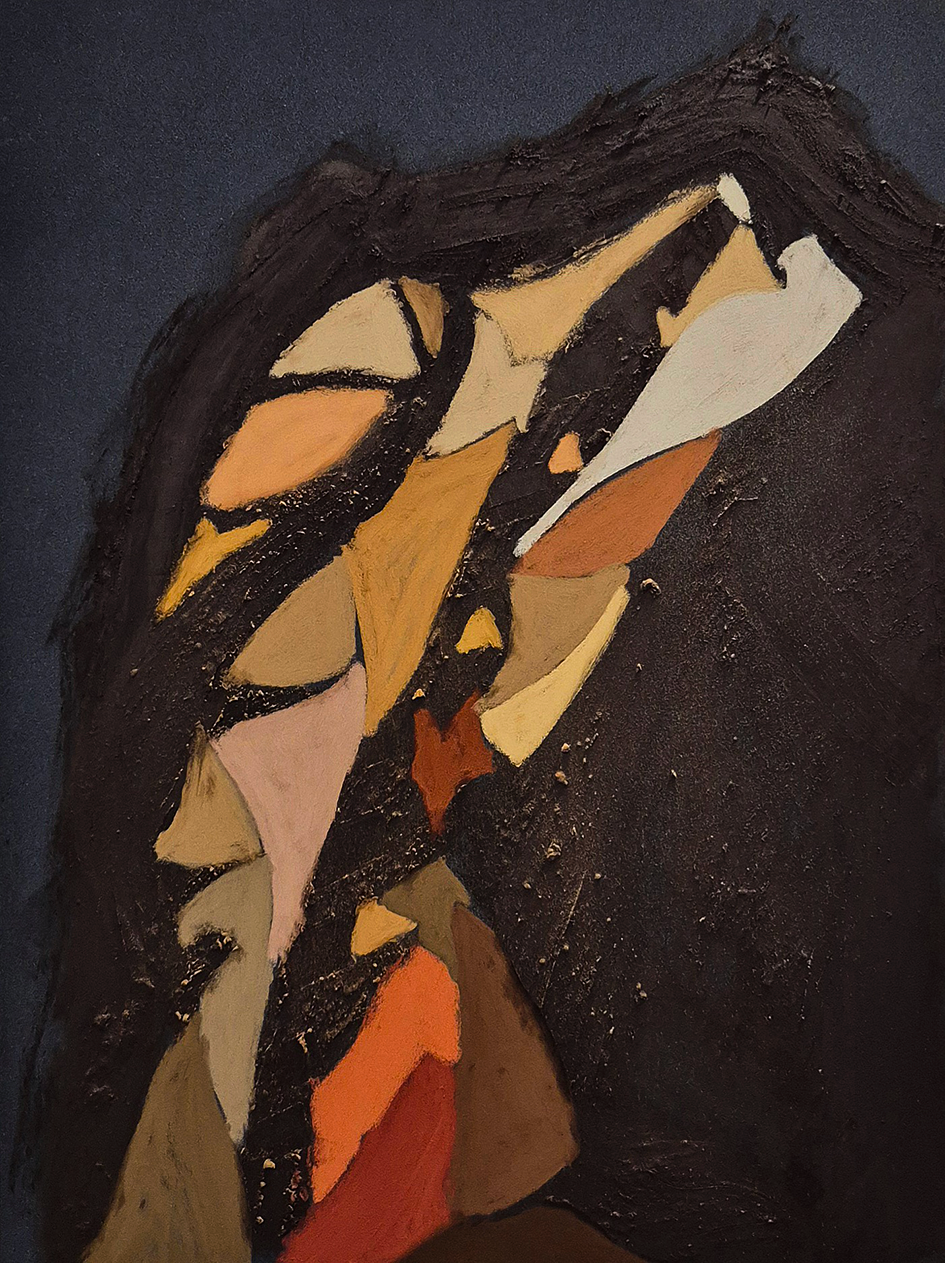
Deconstructing my protectors (2026)
Referred to in the above text “Being ‘in consent with’ my artwork”
Other artists’ exhibitions and artworks
Creating my artworks
Print making
Metalpoint drawing
Deep-dives on completed artworks
Passage
This artwork was made from ink using acid-etched copper plates, plus charcoal, graphite and pastel, all on paper